
School me on beams

juberafab

Well-known member
Joined
Apr 13, 2022
Messages
259
Hello, my fellow beamers!
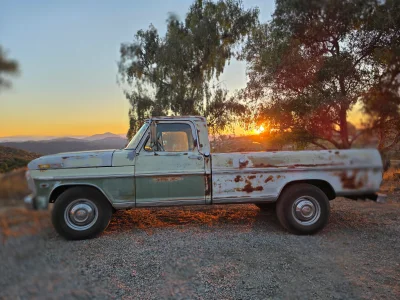
My son has a 69 f100 that we will be starting a build on pretty soon. I would like to get some options on suspension geometry pertaining specifically to equal length beams, etc. I have never built a beam set up. I have set up quite a few beam trucks, so I am not new to this. Most of the geometries are set by the designer. I like to focus on suspension geometry as I am a true believer that the bones of a truck must be set up to the best of one's abilities. I also believe this helps with shock tuning later on. So let's get into it and I would like to hear you theroies, and why.
I will be walking my son from start to finish and plan to document this process on this forum. (I tried to find a thread specifically for this, but couldn't find one).
Thanks!
 

Attachments

  • 20250731_194247.webp
    20250731_194247.webp
    1.2 MB · Views: 5
You got you a smart kid!
The secret to beams is mostly in the steering same as arms

One important point on beam geometry is the radius arms. You want them slightly angled up (frame pivot lower than beam connection) from ride height.
This helps with harshness as the wheel will travel backwards as it compresses. If the rad is angled downward toward the front wheel at ride height it has to travel forward on the arc as it compresses

Also, hot take: I don’t believe centermounted radius arms are all that wonderful.
Their purpose is to eliminate or lessen caster change.
Here’s my take. With normal radius arms Your caster is going to increase from ride height to bump which is going to increase the mechanical bind in the steering and help keep your wheels pointed straight and lessen load on the steering components. That doesn’t sound like a terrible thing to have happen in a whoop section or landing off a jump if you ask me.

That’s all I got.
 
You got you a smart kid!
The secret to beams is mostly in the steering same as arms

One important point on beam geometry is the radius arms. You want them slightly angled up (frame pivot lower than beam connection) from ride height.
This helps with harshness as the wheel will travel backwards as it compresses. If the rad is angled downward toward the front wheel at ride height it has to travel forward on the arc as it compresses

Also, hot take: I don’t believe centermounted radius arms are all that wonderful.
Their purpose is to eliminate or lessen caster change.
Here’s my take. With normal radius arms Your caster is going to increase from ride height to bump which is going to increase the mechanical bind in the steering and help keep your wheels pointed straight and lessen load on the steering components. That doesn’t sound like a terrible thing to have happen in a whoop section or landing off a jump if you ask me.

That’s all I got.
I appreciate the reply and this aligns with my though process. I was explaining all these points to my son last night on our drive to get dinner. I have never messed with centermount radius arms but I do know it helps with tire clearance as well. I will model both when we start designing and see if there is any actual gains
 
In regards to center mount radius arms, i personally dont see much of a benefit as Marcel said. Additionally you have to disassemble the entire front suspension to remove the transmission and possibly other components depending on how the truck is built. For serviceability of the drivetrain i dont see it being productive but i could be wrong.
 
Center mount radius armis for chasing the best geometry out of beams, lots of race trucks do it for this reason, it helps the chassis take load evenly also, making for a stronger chassis. race=centered radius arms, Prerunner, either is fine.
 
That truck should have 7/8" kingpins, which are totally fine — even for hard prerunning. The weak point isn’t the kingpins themselves, it’s the factory bearings. Ditch the bearings and replace them with machined silicon-bronze bushings. The bearings can (and will) collapse.


It should also be rear-steer. If you want to convert to front-steer the cheap way, you can swap the current knuckles around. If I remember right, it’s side-to-side and flipped, but I can’t recall the exact orientation. Either way, as long as the caliper bleeders end up at the top when you’re finished, you’re good.


If you want the strongest factory I-beam setup for that truck, look for the 1" “Camper Special” beams. There’s also a weird crossover year — ’79–’80 — where you could get those beams with 5-lug hubs, if you want to stay 5-lug instead of going full 8-lug.


Rear-steer does tend to be more prone to bending tie rods, especially if your tie rods have bends in them already.


That’s about the best I can do from memory — it’s been 20 years since I messed with this stuff. Good luck.
 
Out of curiosity, is there a single/group of center mounted beamed trucks that are absolutely blowing the doors off frame mounted radius armed trucks? I don't follow racing closely to be in the know. That said, I'm in agreement with Marcy.
 
Thanks for the info. We will be developing our own beams. I was planning to stay away from a king pin set up but havent made my mind up. Might run a uniball or heim setup with machined knuckels. We already produce dana 44 knuckels for TTB but plan to simplify the set up more. I really want to design a billet beam. But might take the opportunity to allow our sone to get better at welding with a fabricated design. We will be going with a more standard steering and ditch the rear steer. Probably use a gm Saginaw box as the one on our race truck to keep parts interchangeable and add a ram assist.
 
Out of curiosity, is there a single/group of center mounted beamed trucks that are absolutely blowing the doors off frame mounted radius armed trucks? I don't follow racing closely to be in the know. That said, I'm in agreement with Marcy.
ODRMSE and Jonno in the Psychotic Tundra.

Fucking DOMINATED back in the day
 
I wouldn’t attribute the success of any race vehicle to one single thing. Winning trucks are usually the result of a bunch of different design choices that all stack together.


There are plenty of super fast radius arm trucks that aren’t center-mounted. That said, if you’re chasing the absolute best geometry and handling, the center-mount setup is hard to beat.


If I built a beam truck tomorrow and it wasn’t for racing, I 100% would not run a center-mounted radius arm setup — mainly because I’d prioritize ease of maintenance (like being able to drop the transmission without everything being in the way).
 
Regarding the knuckle-to-beam attachment, the current “best” design is the heim / uniball configuration. It’s proven to be race-strong, low maintenance, and easy to service — plus you get easy camber adjustment.


For prerunners though, it’s more of a “whatever you want and what your budget allows” scenario. Kingpins, TTB ends, etc. work totally fine and are a much better budget-friendly option.
 
For me if the benefits of centermount radius arms really outweighed traditional mount I would go that route. A few more bolts to drop the trans is not a big deal. I will alreadybe pissed if I have to drop the trans.lol Based on the responses on here it could go either way. I could see some minor benefits in suspension geometry but doubt the average offroad driver would notice the difference .
What caster #s are most running. Around 6* to 10* to combat caster change at droop. I have heard of people.running 10 to 13* on strictly off road but this will need to have some road manners. Not just go in a straight line.
KPI angle will be set up for 39 so if he wants to run 37 or 40 it won't be way off. some tire scrub won't be the end of the world.
 
Back
Top